How Mosquito Spray Treatment Is Applied Around a Home
Last updated: September 10, 2026
Key Takeaways
- Mosquito spray treatment is usually applied as a targeted perimeter spray around places mosquitoes rest, not as a blanket fog over the whole yard.
- A typical application focuses on the house perimeter, shaded planting beds, downspout areas, and anything holding water within about 50 feet of the structure.
- Dog bowls, outdoor toys, vegetable beds, and fish ponds change what can be sprayed and how.
- The label determines where a product can be applied, how it is handled, and when reentry is allowed.
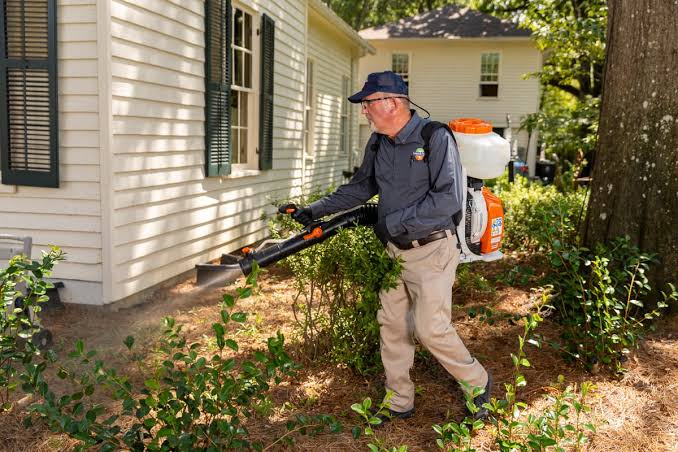
Mosquito spray treatment is usually applied as a targeted perimeter spray around places mosquitoes rest, not as a blanket fog over the whole yard. So if you want to understand how mosquito spray treatment is applied around a home — or what a homeowner should expect during a service visit — begin with the pattern, the treated surfaces, and the method’s limits. Health matters here. Because this is a health-related topic, talk with a qualified pest professional or clinician about your own situation if anyone in the home has asthma, pesticide sensitivity, pregnancy concerns, or a recent reaction to insect products.
Who this is for — and what I’m assuming you already know
Homeowners, renters with yard access, and property managers all fit this. But if your situation involves health sensitivity or a complex property, consult a qualified pest professional. I’m assuming you already know the plain parts: mosquitoes breed in standing water, they bite at dusk and dawn, and a “spray treatment” is not the same thing as removing water sources. In practice, that distinction gets blurred all the time.
The term you will hear most often is barrier spray: a targeted outdoor application intended to leave residue on surfaces where mosquitoes rest, such as shaded vegetation, under decks, and along the outside edge of a structure. Fogging is different. It disperses tiny droplets into the air and usually gives shorter-lived contact coverage.
A lot of generic advice misses the mark by treating every yard the same, so a qualified pest professional should assess the site before choosing a pattern. Lot size sounds decisive, but it really isn’t; a 0.1-acre yard can be trickier than a 2-acre one. What matters is where the mosquitoes shelter. Dense hedges, ivy, leaf litter, crawl-space vents, and shaded fence lines change the plan more than acreage does.
I’m not recommending that a reader with respiratory illness, strong chemical sensitivity, or an infant’s sleep area nearby handle this without professional input. In those cases, the right next step is a pest-management professional who can explain the active ingredient, label directions, and reentry timing, and a clinician if there is a health concern about exposure. For everyone else, three questions matter: where is the spray applied, what gets skipped, and what would count as a poor application?
What mosquito spray treatment around a home actually targets
Mosquito spray around a home is aimed at resting sites, not at open air. That’s the whole point. Adult mosquitoes spend much of the day in cool, humid, protected places, so technicians focus on the underside of leaves, shaded shrubs, the lower 3 to 6 feet of dense vegetation, fence lines, and protected structural surfaces where insects pause after flying in from breeding areas.
Usually, a standard treatment covers the perimeter within roughly 10 to 20 feet of the house, though the exact zone depends on the lot layout and label instructions for the product being used. Deck undersides, porch ceilings, eaves, and screened-enclosure frames may be included if they are common resting points. What is usually not treated is an entire lawn from edge to edge, because grass is not the main resting habitat.
The aim is contact with surfaces, not soaking plants until they drip. Good coverage looks even and light, with visible wetting but no runoff. If you see pooling on mulch, puddling on patio pavers, or leaves dripping after a pass, that is a sign the application is too heavy. If the spray only hits the center of shrubs and misses the shaded interior or the lower leaf surfaces, coverage is too thin in the wrong place.
A generic article often turns this into “spray the yard” and calls it done. Not even close. The structure of the property changes the job. A home bordered by a drainage swale or a heavily shaded tree line may need focus on the side yard, while a house with open sun and little vegetation may need less perimeter treatment and more source control. Honestly, that trade-off is why mosquito work is usually paired with water-habitat cleanup rather than treated as a stand-alone fix.
How is mosquito spray treatment applied around a house?
It is applied as a directed outdoor spray to resting sites, following the product label and the property layout. The method matters more than the brand name, and a qualified pest professional can help match the application to the site.
- Walk the property first. I would inspect the house perimeter, shaded planting beds, downspout areas, and anything holding water within about 50 feet of the structure. Verify where mosquitoes are likely to rest and where water collects. A problem is treating blindly before finding the shaded side of the yard or a clogged gutter.
- Remove or empty standing water before spraying. Buckets, planters, toys, tarps, and birdbaths should be checked first, because a spray does not solve a breeding site. Verify that water is gone or refreshed. If the same container keeps refilling after rain, the source has not been addressed.
- Set up the application for low, controlled drift. Many outdoor applications use a fan or coarse spray rather than a fine mist, because smaller droplets drift more easily. Verify that wind is calm enough for accurate placement and that neighboring windows, play areas, and pet zones are avoided or protected as the label requires. A problem is visible blowback onto patios or doors.
- Treat resting surfaces, not the open air. Apply to the underside and interior of hedges, the lower 3 to 6 feet of shrubs, shaded fence lines, eaves, porch ceilings, and similar surfaces where mosquitoes land. Verify that the spray reaches dense, cool areas. If only the outer leaf surface gets wet, the treatment is likely misplaced.
- Keep the coat light and even. A proper pass should moisten the surface without runoff. Verify there is no dripping from leaves, wood, or siding. Runoff means excess chemical can end up on the ground, where it offers little benefit and adds unnecessary exposure.
- Cover likely entry edges around the home. The perimeter near doors, garage edges, screened openings, and shaded corners often gets attention because mosquitoes collect where people enter and rest. Verify that these zones are included without spraying inside living space unless the label explicitly allows that. A problem is treating a doorway so heavily that it becomes slippery or creates indoor odor concerns.
- Respect label-specific reentry and drying time. The product label controls when people, pets, and children can return to a treated area. Verify the surface is dry before normal use, and do not assume a fixed time across products. A problem is letting children or pets onto wet surfaces too soon.
- Document what was treated. A competent application should be explainable: which sides of the house, which shrubs, which shaded structures, and which water sources were corrected. Verify that the same pattern can be repeated or adjusted later. A problem is a service visit with no record of where the spray went.
That sequence sounds simple, but the details matter. A technician using a backpack sprayer, a hose-end sprayer, or a hand sprayer still follows the same logic: find resting habitat, treat the habitat, and avoid overspraying. If you can’t tell the difference between coverage on a hedge and spray on a driveway, the job is being done poorly.
What should be checked before anyone sprays?
The property should be checked for water, wind, access, and people before a drop is applied. This is where many people lose effectiveness and create avoidable exposure, so a qualified pest professional should review the site before treatment if there is any doubt.
Wind matters because it changes where droplets go. A light breeze can move spray off target and onto a neighbor’s lawn, a parked car, or a child’s sandbox. If conditions are gusty, the application should be delayed. The same goes for rain in the immediate forecast, because rainfall can wash product off surfaces before it has any meaningful chance to remain where it was placed.
Access matters because the best mosquito habitat is often behind the visible front yard. Side yards, under-deck areas, shrubs against a fence, and the back of a shed are easy to miss. If the applicator never reaches those places, the treatment will look complete and still underperform. Bit of a mirage, really.
People and pets matter because a yard is not empty space. Dog bowls, outdoor toys, vegetable beds, and fish ponds change what can be sprayed and how. I’d be cautious about any approach that treats the home perimeter as if it were a vacant lot. It isn’t.
A second check is whether the mosquitoes are actually coming from the property or from nearby water and vegetation outside the property line. If the infestation is driven by a ditch, swamp, retention pond, or dense common area next door, a home-only treatment may give only partial relief. That’s not failure; it is a sign the problem source extends beyond the treated zone.
When should mosquito spray treatment around a home stop?
It should stop when the situation makes spraying the wrong tool or the wrong level of risk. That is the honest answer, and a qualified pest professional should help confirm the call.
Strong wind or rain is expected within hours: the spray is unlikely to stay on target or remain on surfaces — postpone the treatment until conditions improve.
There are open vegetable beds, pollinator plantings, or a pond that cannot be protected: overspray can hit non-target areas — use a more selective approach and speak with a qualified professional about label limits.
Someone in the home has a known sensitivity to insect products, or there is a recent respiratory reaction history: exposure risk matters more than convenience — get professional guidance before any application.
The mosquitoes are breeding in a drainage issue, gutter overflow, septic problem, or standing water that returns after every rain: spraying alone will not solve the source — fix the water problem first.
The planned treatment would require spraying inside living space, over bedding, or onto food-contact surfaces: that is not normal perimeter work — stop and use a method that is explicitly labeled for that use, if any, or consult a professional.
The property includes bees, butterflies, or other non-target insect habitat directly in the spray zone: collateral impact becomes part of the decision — modify the plan or avoid treatment near that area.
A lot of readers want a simple yes-or-no answer here. The real answer is that mosquito spray around a home is a perimeter and resting-site tool. If the job requires ignoring the label, overspraying to compensate for bad placement, or forcing a treatment through unsafe conditions, it is the wrong approach.
The mistakes people make, and what they cost
The first mistake is spraying the lawn like it is the target. That usually wastes product and leaves the shaded resting places untouched. The better alternative is to focus on shrubs, eaves, protected corners, and the undersides of leaves.
The second mistake is treating standing water as an afterthought. A bucket of water, a clogged gutter, or a flowerpot saucer can keep producing mosquitoes after the spray is gone. The right alternative is to remove water first, then spray the resting habitat.
The third mistake is using too much liquid because more looks stronger. Excess wetting leads to runoff and drift, not better control. The proper choice is a light, even coating that stays on target.
The fourth mistake is ignoring wind and timing. A treatment done in a breeze can end up on the wrong side of the property or on a neighbor’s patio. The correct alternative is to wait for calmer conditions and better drying time.
The fifth mistake is assuming every yard needs the same pattern. A shaded, densely planted property and a bright, open one do not behave the same. The correct alternative is to inspect the site first and change the pattern to match the resting habitat.
A sixth mistake is forgetting that label directions are part of the method, not paperwork. The label determines where a product can be applied, how it is handled, and when reentry is allowed. Skip that step, and the whole thing turns into guesswork.
How long does it take, and what does a good result look like?
A typical treatment visit is often completed in under an hour for a small to medium-size home, though the exact time depends on how many shaded areas, outbuildings, and water issues are present. Time is not the best measure of quality. Coverage and placement are.
A good result looks like this: the resting sites were identified before spraying, the application reached shaded vegetation and structural edges, the surfaces are evenly damp rather than dripping, and there is a clear explanation of what was left alone. The house perimeter should not look soaked, and the yard should not smell or feel like it was flooded with product.
That last point matters because mosquito treatment is a precision job, not a spectacle. If someone finishes a visit by saying they “got everything,” I would want to know what that meant. Everything is not a useful target. The underside of dense shrubs, the back side of fence lines, and the exterior eaves are useful targets. Open turf is usually not.
If you are comparing professional help, the most useful questions are simple: What area do you treat? What resting sites do you target? What do you skip? What are the reentry rules? Those answers tell you far more than a pitch about “stronger spray.”
What does the research say about home mosquito spray work?
It suggests that barrier-style control is studied more often than many readers expect, but the evidence is not huge and the details vary. A PubMed search using mosquito[Title/Abstract] AND inspection[Title/Abstract] AND humans[MeSH Terms], filtered to 2016–2026 and read as the 26 most relevant records, found 26 PubMed records matching the query for that window; the 26 most relevant were read and every median, range, and share below is computed across those records — note: the search was widened because the full subject had too little published on it, so these figures describe the wider subject rather than this exact question, computed on 2026-09-10 from PubMed (NCBI). Of those 26, 2 (7%) were tagged Meta-Analysis and 2 (7%) were tagged Systematic Review, both from PubMed (NCBI); 1 (3%) was tagged Observational Study, 1 (3%) was tagged Randomized Controlled Trial, and 1 (3%) was tagged Review, all from PubMed (NCBI). The median publication year was 2020 from PubMed. The CDC notes that mosquito control works best when source reduction and targeted adult control are combined with label-directed use of insecticides, and EPA guidance emphasizes following the product label and avoiding overspray.